Best AI Tools for Dental Practices in 2026
Five dental AI tools have FDA 510(k) clearance for US practices in 2026. Overjet, Pearl, and VideaHealth handle 2D radiograph analysis for general diagnostics; Diagnocat and Orca Dental AI cover 3D CBCT and orthodontic workflows. Beyond imaging, ChatGPT and Claude handle patient communication, marketing, documentation, and practice operations with no clearance needed.

Five dental AI tools currently hold FDA 510(k) clearance for clinical imaging use in the United States. Three of them analyze standard 2D radiographs (bitewings, periapicals, panoramics) for caries, bone loss, and pathology detection. Two cover specialty workflows: CBCT segmentation and cephalometric analysis. Beyond imaging, general-purpose large language models like ChatGPT and Claude are handling a growing share of non-clinical practice work (patient communication, insurance documentation, marketing, hiring) with no FDA clearance needed because they make no diagnostic claims.
Most “best AI tools” lists you will find on dental industry sites are either sponsored content with undisclosed vendor relationships, or they were written in 2023 and never updated. Some list tools that no longer exist. Others treat every feature labeled “AI” as equivalent, whether it is an FDA-cleared diagnostic overlay or a chatbot that auto-fills appointment reminders. This guide is organized by what the tool actually does, with FDA clearance status verified against the 510(k) database as of February 2026.
This is written for three audiences: the solo practitioner evaluating whether any AI tool is worth the investment, the group practice comparing vendors before committing to a contract, and the DSO operations team planning a multi-location rollout. If you already know which category you need, skip to that section. If you are starting from zero, read straight through. The imaging section comes first because that is where the FDA-cleared tools live, followed by non-clinical AI applications where the barrier to entry is much lower.
Imaging and diagnostics: the FDA-cleared tools
This is the category where regulatory status matters. If a tool is analyzing your radiographs and suggesting clinical findings, it needs FDA clearance. If it does not have clearance, you are either using it off-label or the vendor is making claims they should not be making.
General diagnostic AI (2D radiographs)
Three tools compete in this space. All three analyze standard 2D dental radiographs (bitewings, periapicals, and in some cases panoramics) for caries detection and other pathology. They differ in what they are cleared for, how they output findings, and which practice management systems they connect to.
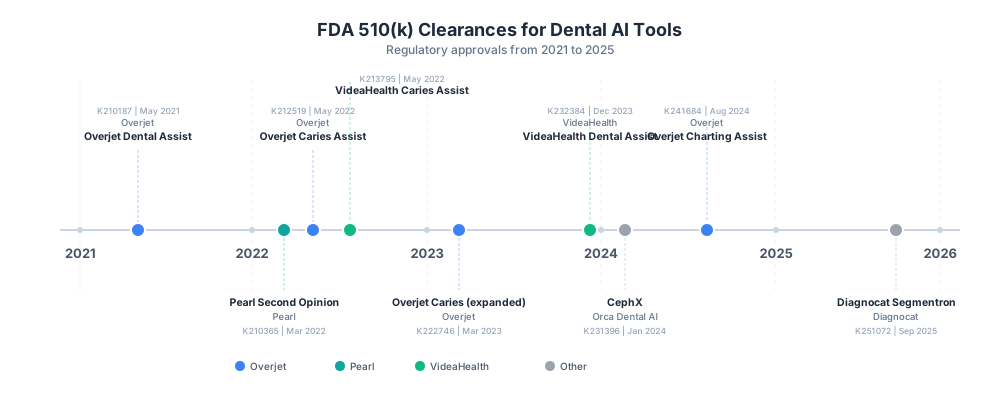
Overjet: best for quantitative measurements. Overjet holds separate 510(k) clearances for bone level analysis (K210187), caries detection (K212519), and automated charting (K241684). The bone level measurement is the differentiator: it outputs a numerical percentage of bone level relative to root length, which gives you a quantitative periodontal measurement rather than a binary “bone loss detected” flag. Overjet integrates with Dentrix, Eaglesoft, and Open Dental. Pricing requires a sales conversation; see our pricing guide for what to ask. For a detailed regulatory comparison with its closest competitor, see Overjet vs. Pearl: what the FDA clearance letters actually say.
Pearl: broadest pathology coverage in a single clearance. Pearl’s Second Opinion platform (K210365) detects caries, periapical radiolucencies, calculus, crown findings, filling findings, implant findings, bridge findings, root canal findings, and restoration margin discrepancies, all within one 510(k) clearance. That is the widest range of pathology types covered by a single dental AI filing. Pearl integrates with five practice management systems, including Dentrix, Eaglesoft, Open Dental, Curve, and Carestack. For multi-location practices, the Practice Intelligence dashboard provides cross-location analytics. Full regulatory comparison: Overjet vs. Pearl.
VideaHealth: largest training dataset, strong DSO partnerships. VideaHealth’s 510(k) clearance (K213795) covers caries detection on 2D radiographs with real-time analysis overlays. The company reports training on the largest labeled dental radiograph dataset among its competitors, though independent verification of dataset size claims is difficult for any vendor. VideaHealth has established partnerships with several large DSOs. It is also available as “Detect AI” inside Dentrix Ascend. If your practice already runs Ascend, VideaHealth is the built-in option rather than a third-party integration. For details on how this works, see Dentrix Ascend AI features explained.
How to choose between the three. This is not a ranking. The right tool depends on your practice.
If you are a solo practitioner and periodontal measurement precision is important to your workflow, Overjet’s quantitative bone level output gives you something the other two do not: a number, not just a highlight. If you run multiple locations and want a single dashboard showing detection patterns across sites, Pearl’s Practice Intelligence platform is built for that use case. If you are already on Dentrix Ascend and want the lowest-friction path to AI-assisted diagnostics, VideaHealth is embedded in your existing software, with no separate integration to manage.
All three require sales conversations for pricing. None publish rates on their website. Our pricing guide explains the four pricing models in play (per seat, per scan, per location, enterprise) and gives you a list of questions to ask before signing.
Specialty imaging AI (CBCT and orthodontic)
Two FDA-cleared tools cover workflows that the general diagnostic tools do not touch: 3D CBCT imaging and cephalometric analysis. These are complementary to the tools above, not replacements.
Diagnocat: the only FDA-cleared CBCT segmentation tool. Diagnocat’s Segmentron module received 510(k) clearance (K251072) in September 2025. It performs automated 3D segmentation of CBCT scans, generating models that can be exported as STL files for surgical planning, implant workflows, and patient consultations. This is the newest FDA-cleared dental AI tool on the US market and is still in early stages of US commercial adoption. If your practice uses CBCT for implant planning or endodontic assessment, Diagnocat is currently the only option with US regulatory clearance for automated segmentation.
Orca Dental AI: FDA-cleared cephalometric analysis. Orca’s 510(k) clearance (K231396) covers automated cephalometric landmark identification and 3D-to-2D cephalometric conversion from CBCT data. This is an orthodontic workflow tool: it automates the landmarking process that orthodontists and oral surgeons currently do manually or with semi-automated desktop software. Orca offers a 7-day free trial, which is unusual in this market. Most vendors require a sales call before you can test anything.
These two tools serve different specialties and different imaging modalities. Neither competes with Overjet, Pearl, or VideaHealth. If you are a general practitioner evaluating AI tools, the 2D radiograph tools above are your starting point. If you are an orthodontist or oral surgeon, Orca and Diagnocat are worth evaluating alongside the general diagnostic tools, not instead of them.
Practice management AI
Not everything labeled “AI” in your practice management software is actually AI. Some features are rule-based automation. Some are database queries with a new interface. Some are genuine machine learning.
Dentrix Ascend, the cloud version of Dentrix, has rolled out several features marketed under the AI umbrella. We wrote a detailed breakdown of which Dentrix Ascend features are genuine AI, which are automation, and which are neither. If you are evaluating Ascend’s AI claims, start there before making purchasing decisions based on feature lists.
On the scheduling side, AI-driven appointment optimization is one of the more practical non-imaging applications. The core idea is using historical data (cancellation patterns, no-show rates, procedure duration variance) to suggest scheduling configurations that reduce gaps and overbooking. Our AI scheduling optimization guide covers how practices are implementing this, what data you need, and what results are realistic to expect.
Patient communication
This is where general-purpose LLMs earn their keep in a dental practice. No FDA clearance needed. No vendor contract. No integration. You open ChatGPT or Claude, paste in some context, and get usable output.
Google review responses. Every practice needs to respond to Google reviews, and most do it badly or not at all. ChatGPT is effective at generating responses that acknowledge the patient’s experience without violating HIPAA. The key constraint is never confirming that the reviewer is a patient. Our review response guide includes specific prompts and the HIPAA boundaries you need to stay inside.
Patient follow-up emails. Post-procedure follow-ups, reactivation sequences for patients who have not been in for 18 months, treatment plan acceptance nudges. Claude handles the tone well: professional without being stiff, warm without being fake. See our follow-up email prompt library for templates you can adapt.
Marketing content. Social media posts, newsletter copy, website pages, patient education handouts. ChatGPT is the workhorse here for volume. Our marketing prompts guide gives you prompts organized by content type. If you are building or rebuilding your practice website from scratch, the website building guide walks through using AI for site structure, copy, and SEO from the ground up.
Clinical documentation
Insurance companies and specialists do not care how polished your marketing copy is. They care about clinical specificity, correct terminology, and documentation that supports the treatment you are recommending or the claim you are submitting. This is where Claude tends to outperform ChatGPT. The longer context window and instruction-following precision matter when you are generating multi-paragraph clinical narratives.
Insurance narratives. Pre-authorization letters, claim narratives, appeal letters for denied claims. The prompt needs to include the specific procedure codes, clinical findings, radiographic evidence, and the patient’s treatment history. Our insurance narratives prompt library includes prompts for the most commonly denied procedures and the specific language insurance reviewers look for.
Referral letters. When you refer a patient to an endodontist, periodontist, or oral surgeon, the referral letter needs to be clinically precise and include the right information for the specialist to triage effectively. Our referral letter prompt guide covers the format and content expectations by specialty.
SOPs and training materials. Standard operating procedures for clinical workflows, front desk protocols, new hire training documents. These are documents most practices know they need and never get around to writing. Our SOPs guide shows how to use AI to generate first drafts that you then edit for your specific practice. Not a finished product, but a starting point that saves 10-15 hours of writing per document set.
Hiring and growth
Staffing is the problem that will not go away. Finding, screening, and onboarding dental assistants, hygienists, and front desk staff costs time that most practice owners do not have. AI can compress the writing-intensive parts of this process.
Job postings that actually attract candidates. Interview question sets tailored to the role. Onboarding checklists and training schedules. Offer letter templates. These are all text-generation tasks where ChatGPT and Claude produce usable first drafts in minutes. Our AI-assisted hiring guide walks through each stage of the hiring funnel with specific prompts and examples.
Which AI model for non-clinical tasks
For everything outside imaging, the documentation, communication, and operations work described above, you are choosing between ChatGPT (GPT-4o or GPT-4.5), Claude (3.5 Sonnet or Opus), and Gemini. They are not interchangeable. Each has strengths that matter for specific dental practice tasks.
The short version: ChatGPT is strongest for high-volume content generation and tasks where broad general knowledge matters. Claude handles long-form clinical writing better, follows complex multi-step instructions more reliably, and tends to produce more precise insurance and referral documentation. Gemini integrates tightly with Google Workspace, which matters if your practice runs on Google Docs and Gmail.
We wrote a full comparison with dental-specific test cases covering treatment plan explanations, insurance narratives, and patient communications, scored against actual clinical criteria. If you want to pick one model and standardize on it, that comparison gives you the data to decide.
What is not on this list (and why)
We excluded several tools that appear on other “best dental AI” lists. Here is why.
Dentistry.AI. This company appears to have been inactive since approximately 2020. The website is either down or unchanged. We found no evidence of current product availability, updated FDA filings, or recent customer deployments. Until there is verifiable evidence of an active product, we cannot recommend it.
DentalXR.AI Pro. CE marked for the EU and UK markets but does not hold FDA 510(k) clearance. Without FDA clearance, it is not available for clinical use in US dental practices. If you practice in Europe, this tool may be worth evaluating. For US-based practices, it is not an option today.
Retrace. We have not been able to independently verify Retrace’s current FDA clearance status from publicly available 510(k) database records. The tool may hold clearance that we have not located, or it may be operating under a different regulatory pathway. We are not making a claim either way. We are saying we cannot verify the status, and we do not list tools we cannot verify.
Any tool claiming “AI-powered” without verifiable clearance or testing methodology. The dental technology market has a pattern of attaching the AI label to features that are rules-based automation, simple threshold algorithms, or basic statistical analysis. If a vendor cannot point you to a specific 510(k) clearance number for their diagnostic claims or a published methodology for their non-diagnostic AI features, ask why.
Where to start
If you have read this far and still are not sure where to begin: start with the non-clinical tools. Open a ChatGPT or Claude account, pick one task from the documentation or communication sections above, and try it this week. The imaging tools require sales calls, contracts, integration work, and training. The LLM tools require a browser tab and 15 minutes.
Once you see the value in AI-assisted writing and documentation, the case for investing in imaging AI becomes easier to make, both to yourself and to anyone else who approves spending at your practice. The imaging tools are a bigger commitment with a bigger payoff, but they are not where most practices should start.