Dental AI FDA Clearance Tracker: Every 510(k) Clearance for AI-Powered Dental Imaging Tools
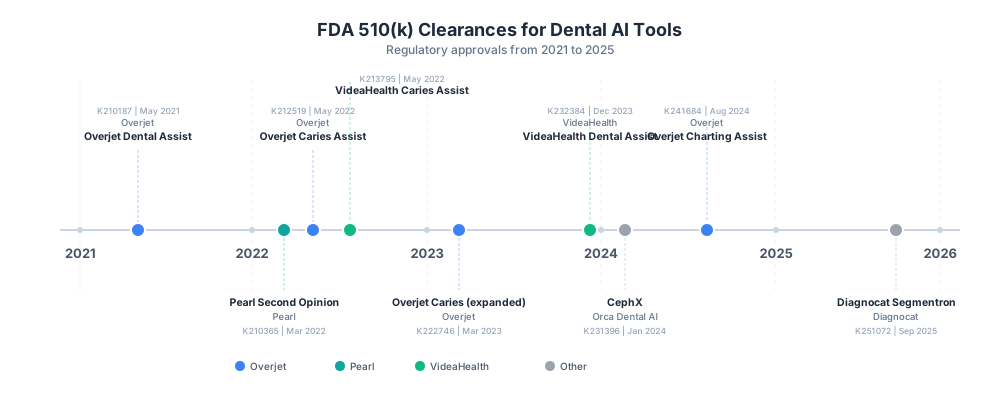
There are currently 8 dental AI tools with FDA 510(k) clearance for diagnostic assistance. This tracker lists every clearance with the clearance number, date, predicate device, and what the clearance actually authorizes, sourced directly from FDA filings.

This page is a standing reference of FDA 510(k) clearances for AI-powered dental imaging and diagnostic software. “510(k) cleared” is not the same as “FDA approved.” Clearance means the FDA determined a device is substantially equivalent to a predicate device already on the market, not that the agency independently validated its clinical accuracy. This tracker covers clearances for AI tools that make radiographic detection or analysis claims for dental applications; we have not included AI scheduling tools, AI billing assistants, or general-purpose LLMs.
How to read this table
Clearance Number links to the FDA’s official decision letter. Predicate Device is the previously cleared device the applicant cited to establish substantial equivalence. It defines the regulatory category and, in practice, the ceiling of what the cleared tool can claim. Indications for Use is the specific statement FDA cleared; this is the only claim the vendor can legally make about clinical function. PMS Integrations lists practice management systems where integration has been confirmed through official partnership announcements or vendor documentation, not marketing copy.
The Tracker
| Tool Name | Company | Clearance Number | Clearance Date | Predicate Device | Indications for Use (abbreviated) | PMS Integrations (confirmed) |
|---|---|---|---|---|---|---|
| Overjet Dental Assist | Overjet, Inc. | K210187 | May 19, 2021 | Not publicly stated in press releases - see FDA filing | AI-assisted measurement of mesial and distal alveolar bone levels on bitewing and periapical radiographs to support periodontal diagnosis and treatment planning | Dentrix, Eaglesoft, Open Dental |
| Overjet Caries Assist | Overjet, Inc. | K212519 | May 10, 2022 | See FDA filing | Concurrent-read CADe software to aid detection and segmentation of caries on bitewing radiographs | Dentrix, Eaglesoft, Open Dental |
| Overjet Caries Assist (expanded) | Overjet, Inc. | K222746 | March 22, 2023 | See FDA filing | Expanded clearance: concurrent-read CADe software to aid detection and segmentation of caries on bitewing and periapical radiographs | Dentrix, Eaglesoft, Open Dental |
| Overjet Charting Assist | Overjet, Inc. | K241684 | August 27, 2024 | See FDA filing | Detect tooth anatomy (enamel, pulp), tooth numbering, implants, crowns, endodontic treatment, and fillings on bitewing/periapical (ages 5+) and panoramic (permanent dentition) radiographs | Dentrix, Eaglesoft, Open Dental |
| Pearl Second Opinion | Pearl Inc. | K210365 | March 4, 2022 | See FDA filing | Concurrent and second-reader AI to identify and highlight suspected caries, periapical radiolucencies, calculus, crown/filling/implant/bridge/root canal findings, and restoration margin discrepancies on bitewing and periapical radiographs; patients 16+ with permanent teeth | Eaglesoft (via Patterson partnership, July 2024), Dentrix, Open Dental, Curve, Carestack |
| VideaHealth Caries Assist | VideaHealth, Inc. | K213795 | May 10, 2022 | See FDA filing | AI-assisted detection and segmentation of carious lesions on bitewing radiographs; patients 18+; output is binary indication plus bounding-box coordinates | Dentrix (via Detect AI partnership), Eaglesoft, Open Dental |
| Videa Dental Assist | VideaHealth, Inc. | K232384 | December 15, 2023 | See FDA filing | Expanded clearance covering 10 clinical pathologies and 25 dental findings including periapical radiolucencies, calculus, and pediatric caries (ages 3+) across bitewing, periapical, and panoramic radiographs | Dentrix (via Detect AI), Eaglesoft, Open Dental |
| CephX (Cephalometric Analysis) | Orca Dental AI Ltd. | K231396 | January 28, 2024 | WebCeph (K220903) | AI-assisted cephalometric analysis software; diagnostic, treatment planning, and simulation tools for use by qualified dentists on patients 14 years and older | Verification pending - not confirmed in official documentation reviewed |
| Segmentron Viewer | DGNCT LLC (Diagnocat) | K251072 | September 9, 2025 | Ez3D-i/E3 by Ewoosoft (K231757) | Semi-automated SaMD for automated analysis of maxillofacial CBCT images using AI to generate segmentation reports for healthcare providers | Verification pending - US commercial launch confirmed late 2025; PMS integrations not confirmed in reviewed documentation |
| DentalXrai Pro | Not confirmed | Not verified | Not verified | Not verified | Not verified - no 510(k) clearance confirmed in FDA database search as of this tracker’s last verification date | N/A |
| Retrace | Not confirmed | Not verified | Not verified | Not verified | Not verified - no 510(k) clearance confirmed in FDA database search as of this tracker’s last verification date | N/A |
Tracker notes:
- Overjet holds at least 7 clearances total as of late 2025, including a CBCT Assist clearance (K243234) announced December 2025. That clearance is not included here because the full filing details had not been reviewed at the time of last verification.
- Pearl holds 8 clearances total as of early 2026, including additional clearances for panoramic radiographs and CBCT. Only the original Second Opinion clearance (K210365) is listed here; the company’s full clearance history is in the FDA database under Pearl Inc.
- DentalXrai Pro and Retrace appear in market listings for dental AI tools but no 510(k) clearances for these product names were confirmed through the FDA database at the time of this tracker’s last update. If either company has obtained clearance, we will add it on next review.
What “510(k) cleared” actually means for your practice
The FDA does not run its own clinical study when it clears a 510(k) device. It reviews whether the submitting company has demonstrated that its device is “substantially equivalent” to a predicate device already legally on the market. That is a different question from: does this AI detect caries accurately? The agency’s clearance is a regulatory finding, not a clinical endorsement.
The predicate device matters more than most practitioners realize. When Overjet cleared its caries detection software using a prior CADe (computer-aided detection) system as the predicate, the regulatory category it entered was detection assistance, the same category as the predicate. That determines the vocabulary the vendor can legally use. A CADe clearance authorizes the claim that the tool assists in detection. It does not authorize the claim that the tool diagnoses. The dentist still makes the diagnosis. A vendor saying their tool “diagnoses caries” without specifying which clearance that claim is based on is either conflating marketing language with regulatory language, or they have a different, broader clearance. Ask them which it is.
“Detection assistance” is the most common indication across this tracker. It means the AI flags findings for a clinician to evaluate; the flagged area is not a diagnosis. For your practice, this means the AI output is input to your judgment, not a substitute for it. That is not a weakness. It is the correct characterization of what these tools are cleared to do.
The sensitivity and specificity numbers vendors publish in their sales materials may come from two different places: the clinical study submitted with the 510(k) application, or a separate post-clearance validation study. These are not interchangeable. The 510(k) study is conducted on a specific dataset, collected at specific sites, under specific imaging conditions. A vendor study run on a broader or different population can show different numbers in either direction. When a vendor cites an accuracy figure, ask them: is this from the 510(k) submission study, or from a separate study? If a separate study, ask for the publication or the methodology. This is not an unusual request. Good vendors have good answers.
510(k) clearance does not evaluate anything beyond safety and substantial equivalence. It does not evaluate the tool’s integration with your practice management software. It does not evaluate whether the tool changes patient acceptance rates or treatment outcomes. It does not evaluate how the tool performs on the imaging hardware in your specific operatories. And it does not regulate pricing. If you want to understand how these tools charge, see our dental AI pricing guide. Every evaluation factor that matters for your workflow is yours to assess independently. If you are comparing specific tools, our Overjet vs. Pearl side-by-side comparison reads the actual clearance letters line by line.
What is not on this tracker
This tracker does not include:
- AI features embedded in practice management platforms (Dentrix, Eaglesoft) that are not separately cleared as medical devices. Henry Schein’s Detect AI, for example, is powered by VideaHealth’s FDA-cleared algorithms. The clearance is VideaHealth’s, not Dentrix’s.
- General-purpose AI tools (ChatGPT, Claude, Gemini) used for non-clinical tasks such as drafting treatment notes, responding to patient messages, or generating marketing content. These are not medical devices and do not require FDA clearance for those use cases. For an overview of both FDA-cleared imaging tools and general-purpose AI applications in dentistry, see our 2026 buyers guide.
- AI tools that do not make radiographic diagnostic claims and therefore fall outside the FDA’s device regulation framework for this context. AI-powered scheduling, insurance verification, payment processing, and patient communication tools are not FDA-regulated as medical devices.
- Non-US cleared tools not yet reviewed for US 510(k) status. Several international dental AI products have CE marking or other regulatory clearances but have not submitted 510(k) applications.
How we maintain this tracker
We check the FDA 510(k) database at accessdata.fda.gov monthly, searching the dental device product codes (LLZ, MYN, QIH, and related codes for Class II medical image management systems) for new clearances. When a new clearance appears, we review the decision letter, update the tracker with the clearance number and the indications as stated in the filing, and update the article’s lastUpdated date. We do not add a tool to the confirmed-cleared rows based on press releases alone; we require the FDA filing.
PMS integration status is verified from official partnership announcements, vendor documentation, or direct company communications. A vendor claiming to “integrate with all major practice management systems” without naming them does not get a confirmed entry in the integrations column.