Every AI Feature in Dentrix Ascend, Explained: What's Included, What Costs Extra, and What's Marketing
Dentrix Ascend markets at least six features as 'AI-powered.' Some of them are genuine machine learning applications. Others are automation features that existed before the AI label got applied. And at least two require purchasing a third-party add-on through Henry Schein. Here's what each feature actually does, how it works, and what it costs.

Henry Schein’s marketing team has discovered the letters A and I. If you’ve been to a dental trade show in the last eighteen months, visited the Dentrix Ascend website, or opened a Henry Schein mailer, you’ve seen the word “AI” applied to scheduling, imaging, insurance verification, patient communication, treatment planning, and analytics. The natural question from any practice owner already paying for Dentrix Ascend is: what changed? Is this new technology, or did someone in marketing relabel the features I already have?
Both, it turns out. Dentrix Ascend does have access to one genuinely significant AI integration: an FDA-cleared machine learning model for radiographic analysis. It also has several automation features that are useful, time-saving, and not AI in any meaningful technical sense. The distinction matters because “AI” implies learning, adaptation, and intelligence. Automation implies rules someone programmed. Both can save you time. Only one of them is going to improve as it processes more data.
This explainer goes through every feature Dentrix Ascend currently markets under the AI or “intelligent” umbrella. For each one, we answer three questions. What does the feature actually do (not what the marketing page says, but what happens when you use it)? Is it included in your Dentrix Ascend subscription or does it cost extra? And is it genuinely AI (a machine learning model making predictions or classifications) or automation (rule-based logic that follows instructions but doesn’t learn from outcomes)?
1. Detect AI (Radiographic Image Analysis)
What the marketing says
Henry Schein One promotes Detect AI as an “AI-powered radiographic analysis tool” that helps dentists identify pathology in dental radiographs. The marketing positions it as a clinical decision support tool that overlays findings on existing X-rays, highlighting areas of concern including caries, periapical radiolucencies, calculus, and bone loss.
What it actually does
Detect AI is VideaHealth’s FDA-cleared machine learning model, distributed through Henry Schein’s dental software ecosystem. VideaHealth received its initial FDA 510(k) clearance for dental AI diagnostic support (you can see the specific clearance details in our FDA clearance tracker), and the underlying technology uses deep learning trained on millions of dental radiographs to identify patterns consistent with specific pathologies.
In practice, the integration works like this: you take a radiograph in your existing imaging workflow, and Detect AI analyzes the image, producing an overlay that highlights suspected findings. Each finding gets a confidence indicator. The dentist reviews the AI’s analysis alongside the original image and makes their own clinical determination. The AI doesn’t diagnose; it flags. You diagnose.
The layering here is important to understand. Dentrix Ascend is the practice management software. Detect AI is a separate product. VideaHealth built the AI model. Henry Schein One packages it as “Detect AI” and distributes it. When Dentrix Ascend says it has AI imaging analysis, what it means is that a third-party AI product is available for purchase through the same vendor.
AI or automation?
Genuine AI. This is a real machine learning model, a convolutional neural network trained on dental radiographs. It learns from data. It has FDA clearance as a clinical decision support tool. This is the most technically legitimate AI feature in the Dentrix ecosystem.
Included or extra?
Extra. Not included in your Dentrix Ascend subscription. Detect AI requires a separate purchase through Henry Schein One. Pricing is typically per-provider, per-month, and as of the information available publicly, runs in the range of several hundred dollars per month per provider. The exact pricing may vary by practice size and contract terms. Your Henry Schein rep will have current numbers.
Verdict
This is a real AI product with real clinical utility, and it’s the one Dentrix Ascend feature that genuinely deserves the AI label. But be clear about what you’re buying: you’re buying VideaHealth’s technology through Henry Schein’s distribution channel. If you want to understand how this compares to alternatives like Overjet and Pearl, see our dental AI pricing guide for cost structures across all three vendors. If VideaHealth launches with another PMS integration tomorrow, the AI doesn’t change; only the distribution does. Ask about pricing, ask about the contract term, and ask whether your imaging hardware is compatible before you commit.
2. Smart Scheduling and Schedule Optimization
What the marketing says
Dentrix Ascend’s marketing references “intelligent scheduling” and “smart schedule optimization” that helps practices fill their schedules efficiently, reduce gaps, and match patients to appropriate appointment slots based on procedure type and provider availability.
What it actually does
The scheduling features in Dentrix Ascend use provider preference settings, procedure duration templates, operatory availability, and scheduling rules to suggest appropriate appointment slots. If Dr. Chen only does extractions on Tuesdays and Thursdays, the system won’t suggest a Monday slot for an extraction. If a crown prep requires 90 minutes and there’s only a 60-minute gap, it won’t offer that gap.
This is useful. Having your scheduling software enforce provider preferences and procedure durations reduces front desk errors, particularly with newer staff who don’t yet know every provider’s scheduling quirks. The system can also identify gaps in the schedule and surface those as opportunities, either for same-day patients or for moving appointments from overbooked days.
What it doesn’t do, based on available documentation, is learn from outcomes. A true AI scheduling system would analyze historical data (no-show rates by patient, procedure conversion rates by time-of-day, seasonal demand patterns) and make predictions. “This Thursday afternoon slot has a 40% no-show probability based on the patient’s history; consider double-booking.” That’s AI scheduling. What Dentrix Ascend appears to offer is rule-based slot matching, which is what dental scheduling software has done in various forms for over a decade.
AI or automation?
Automation. This is rule-based logic. The system follows the scheduling rules you configure. It doesn’t learn from your scheduling data, predict no-shows, or optimize based on historical patterns. “Smart” in this context means “follows rules consistently,” which is valuable but not artificial intelligence.
Included or extra?
Included. Scheduling features are part of the core Dentrix Ascend platform. You’re already paying for this.
Verdict
Good feature, wrong label. If you’re a Dentrix Ascend user, you should absolutely configure your scheduling rules thoroughly: provider preferences, procedure durations, operatory assignments. The system will enforce them reliably. Just don’t expect it to get smarter over time based on your practice’s patterns. It does what you tell it to do, exactly as you tell it. If you want actual data-driven scheduling insights (no-show pattern analysis, recall gap identification, utilization metrics), our guide on AI dental scheduling optimization shows how to export your Dentrix data and analyze it with ChatGPT for free.
3. Automated Insurance Verification
What the marketing says
Dentrix Ascend promotes automated insurance verification as an intelligent feature that verifies patient insurance eligibility before appointments, reducing front desk workload and preventing claim denials from eligibility issues.
What it actually does
When a patient is scheduled, the system can automatically submit an eligibility check to the patient’s insurance carrier through a clearinghouse connection. The clearinghouse queries the payer’s system and returns the patient’s current eligibility status, plan details, remaining benefits, and coverage specifics. This information populates in the patient’s record before they arrive.
The workflow improvement here is real. Instead of your front desk staff manually logging into a clearinghouse portal, entering patient and subscriber information, running the check, and recording the results, the system does it automatically when the appointment is booked or a day before the visit. For a practice seeing 30 patients a day, that’s 30 manual checks eliminated. If each check takes 3-5 minutes of staff time, you’re saving 90-150 minutes of front desk labor daily. That’s meaningful.
But the mechanism is an API call. The system sends structured data (patient ID, subscriber ID, payer ID) to a clearinghouse, which queries the payer’s system and returns structured data. There’s no machine learning model analyzing insurance patterns, predicting coverage issues, or learning from historical verification results. It’s an automated data lookup, the same technology that auto-fills your address when you start typing it on a website.
AI or automation?
Automation. Not even close to AI. This is an API integration with a clearinghouse. It sends a query and receives a response. The “intelligence” is in knowing when to run the check (when an appointment is scheduled) and where to put the results (in the patient record). Those are triggered workflows, not machine learning.
Included or extra?
Mostly included, with caveats. The automation feature is part of Dentrix Ascend, but you need an active clearinghouse relationship, and some clearinghouses charge per-transaction fees for eligibility checks. Your costs depend on your clearinghouse agreement. The Dentrix Ascend subscription includes the automation trigger; the cost of the actual verification depends on your clearinghouse setup.
Verdict
This is one of the most practically useful features in Dentrix Ascend, and you should absolutely have it turned on and configured properly. Automated eligibility verification saves real staff time and catches coverage lapses before the patient is in the chair. It’s just not AI. Don’t let the label set the wrong expectations.
4. Patient Communication and Smart Messaging
What the marketing says
Dentrix Ascend markets “intelligent patient communication” and “smart messaging” that automatically sends appointment reminders, recall notices, and patient outreach messages. Some marketing materials suggest these messages are personalized using AI.
What it actually does
The patient communication system sends automated messages triggered by scheduling events and patient status. When a patient is scheduled, reminder messages go out at configured intervals (typically a week before, a day before, and the morning of the appointment). When a patient is due for recall (usually six months after their last hygiene visit), the system sends recall reminders. When patients haven’t been seen in a defined period, reactivation messages can be triggered.
The messages themselves are templates. You configure the template text, including merge fields for patient name, appointment date, practice name, and phone number. The system populates these fields and sends the message via text, email, or both, depending on your configuration and the patient’s communication preferences.
The question is whether there’s any natural language generation, meaning actual AI writing unique messages for each patient. Based on the documentation available, the answer appears to be no. These are mail-merge templates with scheduled triggers. The “personalization” is the patient’s name and appointment details inserted into a template you wrote (or accepted from the default set). That’s the same technology email marketing platforms have used since the early 2000s.
Some third-party patient communication platforms that integrate with Dentrix Ascend, like Demandforce or Lighthouse 360 (now RevenueWell), may offer more sophisticated messaging. But those are separate products with separate pricing. The built-in Dentrix Ascend communication features, based on what’s publicly documented, are template-based automation.
AI or automation?
Automation. Template-based messaging with merge fields and scheduled triggers. If newer releases have added generative AI for message creation, the public documentation doesn’t reflect it as of this writing.
Included or extra?
Partially included. Basic appointment reminders and recall messaging are part of Dentrix Ascend. More advanced patient communication features (two-way texting, review solicitation, marketing campaigns) may require additional modules or third-party integrations at additional cost. The specifics depend on your subscription tier.
Verdict
Automated patient communication is table stakes for modern dental software, and Dentrix Ascend delivers it competently. Set up your reminder templates, configure your recall intervals, and let the system handle the repetitive outreach. It works. But if your Henry Schein rep tells you it’s “AI-powered messaging,” ask them to show you which part uses machine learning. The likely answer is none of it.
5. Treatment Plan Presentation Tools
What the marketing says
Dentrix Ascend includes features marketed as intelligent treatment planning that help present treatment options to patients with visual aids, cost estimates, and prioritized sequencing.
What it actually does
Treatment plan presentation in Dentrix Ascend lets you build a treatment plan from your clinical findings, assign procedure codes, attach estimated costs (including insurance estimates), and present the plan to the patient in a format that’s more understandable than a list of CDT codes. Some visual aids may be included: diagrams showing which teeth are involved, before/after examples, or educational materials about specific procedures.
Treatment sequencing (the order in which procedures should be completed) follows clinical logic configured in the system. Urgent treatment first, then comprehensive, then elective. Within categories, the sequencing follows standard clinical protocols. This is helpful for presenting multi-phase treatment plans to patients in a way that explains why the extraction comes before the implant comes before the crown.
The question is whether any machine learning is involved in suggesting treatment sequences, predicting patient acceptance rates, or recommending presentation strategies based on historical data. Based on available documentation, there’s no evidence of this. The treatment plan features appear to be structured templates with configurable clinical sequencing, essentially a digital version of what you’d explain on a whiteboard, presented more professionally.
AI or automation?
Automation, with mostly manual configuration. Treatment plans are built from clinical findings you enter. Sequencing follows rules you set. Presentation templates are pre-built. None of this appears to involve machine learning models making predictions or learning from outcomes.
Included or extra?
Included. Treatment planning and presentation are core features of Dentrix Ascend.
Verdict
Good clinical workflow tools. The ability to present a multi-phase treatment plan with cost estimates and visual aids improves case acceptance. Patients who understand what they need and what it costs are more likely to proceed. Use these features. Just recognize them for what they are: well-designed presentation tools, not artificial intelligence.
6. Revenue Cycle Intelligence and Analytics
What the marketing says
Dentrix Ascend promotes analytics and reporting features using language like “revenue cycle intelligence” and “smart analytics” that help practices track production, collections, insurance reimbursement, and financial performance with “intelligent insights.”
What it actually does
The analytics dashboard in Dentrix Ascend aggregates your practice data into reports and visualizations. You can track daily production, collections versus production ratios, insurance aging, accounts receivable, provider productivity, and procedure mix. The system generates standard reports (daily, weekly, monthly) and allows you to create custom views.
The “intelligence” in the reporting appears to be comparative metrics: your production this month versus last month, your collections rate versus a benchmark, your insurance aging bucketed by 30/60/90 days. Some trend lines may be included, showing your trajectory over time. This is standard business intelligence reporting, the same category of tools that every industry uses to visualize historical performance data.
The distinction between BI reporting and AI analytics is whether the system makes predictions. A genuine AI analytics platform would say: “Based on your scheduling patterns and historical no-show rates, your projected production for next month is $X, which is 8% below target. Here are three scheduling changes that could close the gap.” That’s predictive analytics powered by machine learning. What Dentrix Ascend appears to offer is descriptive analytics: here’s what happened, here’s how it compares to the past. Descriptive analytics are useful! Every practice owner should be reviewing their numbers. But describing history is not artificial intelligence.
AI or automation?
Neither, really. This is business intelligence reporting. Standard data aggregation, visualization, and comparison. No machine learning models. No predictive analytics. No recommendations generated from pattern analysis. This is SQL queries and charts, technology that’s been mature for two decades.
Included or extra?
Included. Analytics and reporting are part of the core Dentrix Ascend platform. Some advanced reporting features or custom report builders may be limited to higher subscription tiers.
Verdict
Use your analytics dashboard. Seriously. The number of practices that pay for reporting tools and never look at the reports is staggering. But “revenue cycle intelligence” is a marketing phrase, not a product capability. If you want actual AI-driven practice analytics, the kind that predicts trends and recommends actions, you’d need a third-party analytics platform, and those exist. Dentrix Ascend’s built-in reporting is not that.
7. Clinical Documentation and Charting Assistance
What the marketing says
Some Dentrix Ascend materials reference smart charting or intelligent clinical documentation features that streamline clinical note-taking and charting workflows.
What it actually does
Clinical charting in Dentrix Ascend uses structured templates, auto-text shortcuts, and odontogram-based data entry. You click on a tooth, select a condition or procedure, and the system generates structured chart entries. Clinical notes can use templates with pre-populated text that you customize per visit. Auto-complete and auto-text features let you type shorthand that expands into full clinical notes.
This is standard electronic health record functionality. Structured charting with templates and shortcuts has been the norm in dental EHRs for well over a decade. The efficiency gains are real (template-based charting is faster than free-text note-taking), but the technology is text expansion and structured data entry, not artificial intelligence.
If Dentrix Ascend were using AI for clinical documentation, you’d expect features like ambient listening (recording the provider-patient conversation and generating notes from it) or natural language processing that converts free-text notes into structured clinical codes. Products like Bola AI and others in the dental AI space are working on exactly this. Dentrix Ascend’s charting features, as publicly documented, don’t appear to include this capability.
AI or automation?
Automation. Template-based data entry with shortcuts. No natural language processing, no ambient documentation, no machine learning. This is the dental EHR charting that’s been standard for years with a fresh coat of marketing language.
Included or extra?
Included. Clinical charting is a core EHR feature in Dentrix Ascend.
Verdict
Every dentist should use charting templates and auto-text shortcuts. They save time on every patient encounter. If your charting workflow feels slow, the fix is probably better template configuration, not a new product. But don’t expect intelligence from this feature. It does what your templates tell it to do.
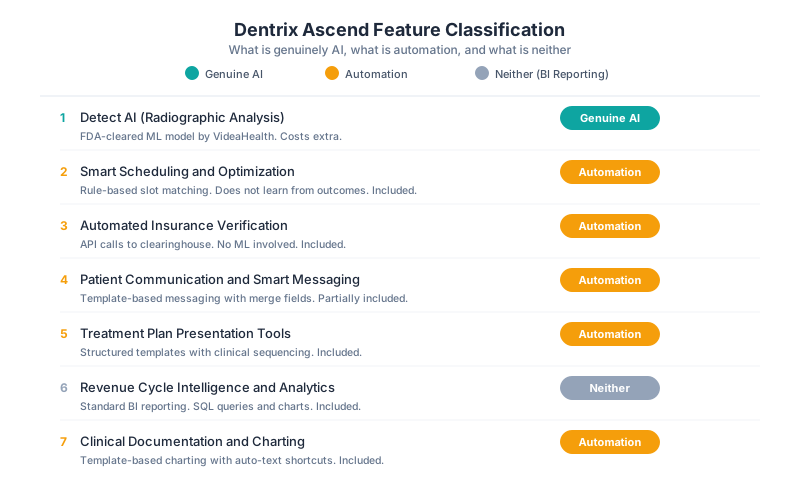
The Real Takeaway
Here’s the honest summary: Dentrix Ascend has one genuinely significant AI feature: the Detect AI integration powered by VideaHealth’s FDA-cleared machine learning model for radiographic analysis. It’s real AI. It’s real technology. And it costs extra.
Everything else currently marketed under the AI umbrella is automation. Scheduling rules. Insurance API calls. Message templates with merge fields. Charting shortcuts. Analytics dashboards. These are all useful features. Some of them are very useful. Automated insurance verification alone probably saves most practices an hour of staff time daily. But they are not artificial intelligence. They don’t learn. They don’t predict. They don’t get better over time. They do what they were programmed to do, exactly as programmed.
The distinction matters for two reasons:
Expectations. When a vendor tells you a feature is “AI-powered,” you expect it to improve. You expect it to learn from your practice’s data and get smarter. Rule-based automation doesn’t do that. If your scheduling optimization suggests the same suboptimal slot for the same patient type every time, it will keep doing that forever unless you manually change the rules. A genuine AI scheduling system would learn from the pattern and adapt. Knowing which you have prevents frustration.
Purchasing decisions. If you’re evaluating Dentrix Ascend against competitors and AI features are a factor, you need to compare apples to apples. Are competitors offering genuine machine learning features, or are they also relabeling automation? The marketing arms race around AI means every dental software company is using the same language. The technical reality underneath varies enormously.
Henry Schein is not unusual in this behavior. Every dental software vendor (Eaglesoft, Open Dental, CareStack, Curve, Planet DDS) is applying AI labels to existing features. This isn’t a Dentrix-specific criticism. It’s an industry-wide pattern, and as a practice owner, your job is to see through the language and evaluate the actual technology.
Five Questions for Your Henry Schein Rep
If you’re a Dentrix Ascend user evaluating the AI features, or if your rep brings up AI in your next contract discussion, here are the questions to ask:
-
“Which features in my current subscription use machine learning models, and which use rule-based automation?” This forces specificity. If the answer is vague (“our platform leverages AI across the workflow”), push back. You want a list.
-
“What is the total monthly cost for Detect AI, per provider, including any clearinghouse or imaging integration fees?” Detect AI is the one feature worth evaluating seriously. Get the real number, not the “starting at” number.
-
“Does my current imaging hardware and software support the Detect AI integration, or will I need additional equipment or software upgrades?” Compatibility matters. If you need a new sensor or imaging software to use the AI analysis, that changes the cost calculation significantly.
-
“Can you show me documentation on which features will include machine learning in the next 12 months, versus which are on a product roadmap without a committed timeline?” Vendors love to sell the roadmap. “We’re adding AI scheduling next year” is different from “AI scheduling is in development with no release date.”
-
“If I add Detect AI, what is the contract term, and can I cancel if the integration doesn’t work with my clinical workflow?” Lock-in matters. A 36-month commitment to a product you haven’t tested in your practice is a significant risk. Ask about trial periods.
A Final Note
None of this analysis means Dentrix Ascend is a bad product. It’s a capable cloud-based practice management system with solid core functionality. The scheduling works. The charting works. The insurance verification saves time. The patient communication reduces no-shows. These are real, practical benefits that justify the subscription for many practices.
The issue is purely about labeling. When everything gets called AI, the term loses meaning. And when a vendor’s one genuine AI feature (Detect AI) gets buried in a list alongside template messaging and insurance API calls, all labeled “intelligent,” the real innovation gets diluted. Detect AI deserves better than being the seventh item on a marketing slide where the first six are automated appointment reminders.
Use the automation features. They’re good. Evaluate Detect AI on its merits and its cost. And when the marketing says “AI-powered,” ask what the power source actually is.